
Eight-Year-Old Boy Attempts Suicide
Psalm 34:18: "The Lord is near to the brokenhearted and saves the crushed in spirit" (English Standard Version).
Introduction
Children take their own lives even at the early age of five. Ruch and colleagues state that childhood suicide stems from “multiple risk factors including mental health, suicidal behavior, trauma, and family or peer relationship issues.”1 My attempt to take my own life at the tender age of eight stemmed from “family and peer relation issues.”
My First Suicide Attempt
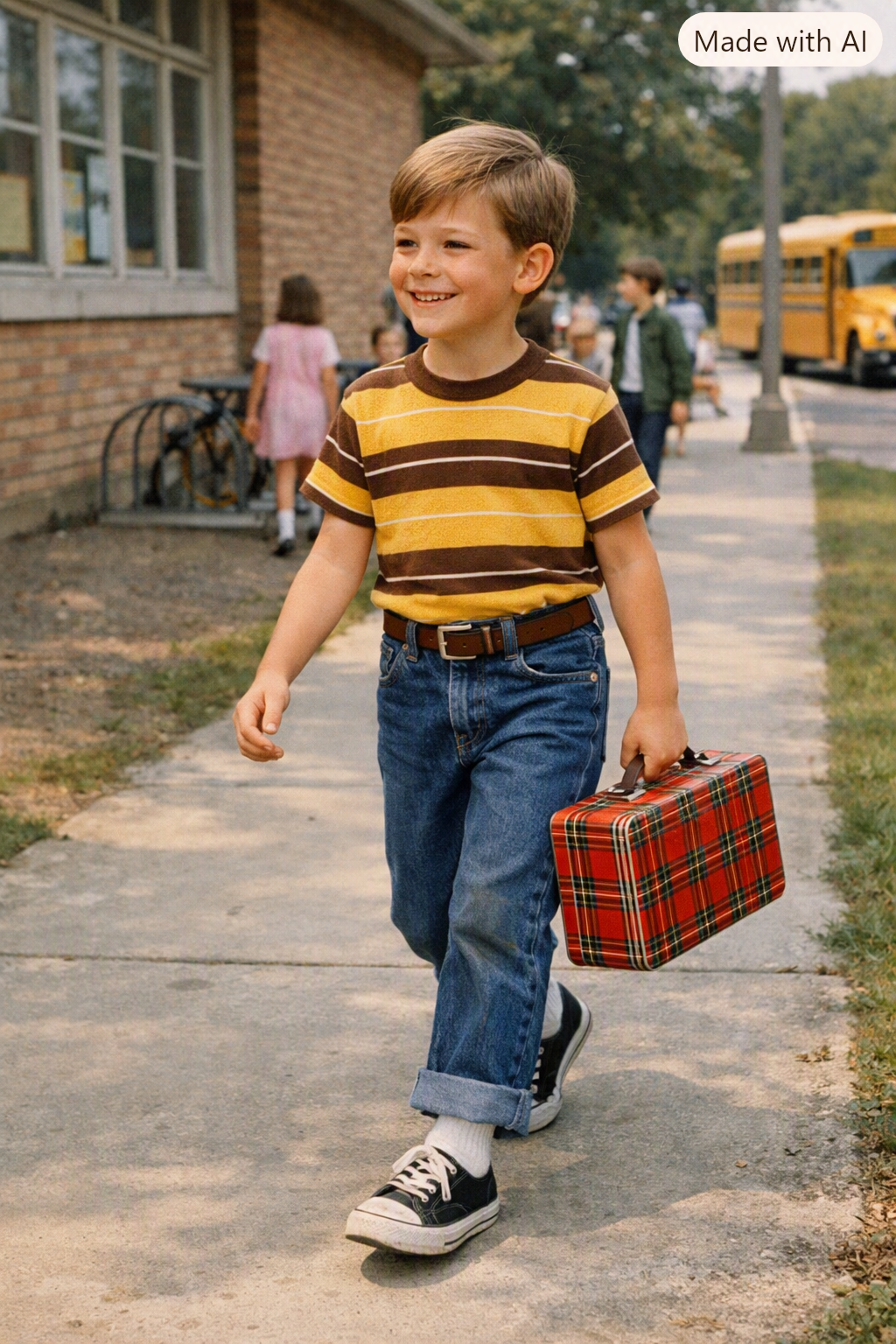
showing an eight-year-old boy walking to school
in 1969 with a red tartan lunchbox.
The year 1969 was a great year for the American public. Apollo 17 landed on the Moon, and Neil Armstrong said, “One small step for man, one giant leap for mankind.” Well, that year was not so great for me. I was in the third grade and took my lunch to school. Back then, thermoses came with glass inserts. Being raised in a culture that promoted “we don’t talk about things like that” caused me a lot of problems. I could not take my problems to my teachers, grandparents, or neighbors. That was where my problems began.
The bullies, Glenn and Kenny, would attack me and take my lunchbox. They would slam it to the ground, breaking the glass in my thermos. When I got home, I told my mother that they attacked me and broke my thermos. She would make me tell my father. He would beat me because they broke my thermos.
You might be wondering why I did not fight back. The answer takes us back to when I was in kindergarten. Some boys and I were playing marbles when the blind boy in our class walked over to us and stepped on my fingers. I jumped up, pushed him, and told him to watch where he was walking. After I got home, I realized what I had done to him was wrong. I prayed and asked Jesus for forgiveness. I promised never to defend myself, but to defend others. To this day, I have never defended myself, but I have defended others who were being attacked.
I got to the point that I felt no one cared about me. I had no safe place. I decided to hang myself in my closet. I got a rope from the hall closet and tied a slip knot so I could put it around my neck. I measured the length to make sure I could not touch the floor while hanging there. I tied the loose end to the clothes bar and stood on a stool. I pushed the stool away. I remember thinking, I am going to heaven because I believe in Jesus. The rope broke, and I fell to the floor. God saved me. I never told my family or friends what I did. This was the first time that I tried to take my own life; I was only eight.
Trauma-Focused Cognitive Behavioral Therapy
One should be able to admit that I experienced trauma at school and at home. This section explains TF-CBT. Morelli et al. note that “Trauma-focused cognitive behavioral therapy is . . . used . . . for children and adolescents presenting with posttraumatic stress.”4 TF-CBT is a treatment program that uses eight to twenty-five sessions to help “improve children’s PTSD [posttraumatic stress disorder] symptoms, improve children's comorbid mental health symptoms (e.g., depression, anxiety, behavioral difficulties), [and] improve children’s adaptive functioning” of youth ages three through eighteen.5 Professionals can integrate storytelling and narratives into TF-CBT.6 Stories and narratives “teach lessons with memorable themes.”7 The right side of the brain processes these stories and narratives, “activate[s] sensory memories, trigger[s] unresolved emotions, and stimulate[s] the ‘aha’ of insight that propels behavior change.”8 In my practice as a pastoral counselor, I often use stories and narratives to help children, adolescents, and adults process the information and stimulate change within them.
Godly Play
Children's minds have not advanced to the mental maturity of adults. Because of this, biblical stories are presented in simpler terms than for adults. Berryman notes that “Godly Play” helps children build their “own meaning about God by the playful interaction of their experience with Christian language.”9 Goodman notes that GP is “godly” because, while playing, children form their own views of God.10 Minor and Sutton-Adams conducted a study with thirteen youths and young adults to determine if GP works.11 The results indicated “that the participants demonstrated relational consciousness concerning self, God, others, and the world, suggesting that Godly Play can nurture children’s spiritual lives into adolescence and beyond.”12 The purpose of GP is to help children build an understanding of God and Christianity that stays with them all their lives.
Conclusion
This article discussed my attempt to take my own life by hanging, TF-CBT, and “Godly Play.”13 TF-CBT offers children, adolescents, and adults the opportunity to heal from the trauma they experienced. GP offers children the opportunity to understand God and Christianity, which they can turn to as they age. The combination of TF-CBT and GP seems to be a strong pairing for helping traumatized children.
Footnotes
1. Donna A. Ruch et al., “Characteristics and Precipitating Circumstances of Suicide Among Children Aged 5 to 11 in the United States, 2013–2017,” JAMA Network Open 4, no. 7 (2021): 8.
2. Ibid.
3. Nicholas M. Morelli et al. “Effectiveness of Trauma-Focused Cognitive Behavioral Therapy for Youth with Complex Trauma Exposure: A Systematic Review,” Trauma, Violence, & Abuse (2025): 1; Geoff Goodman, Spiritual Interventions and Attachment: Seven Models for Clergy, Lay Ministers, and Mental Health Professionals (New York, NY: Routledge, 2026), 107.
4. Morelli et al., “Effectiveness,” 1.
5. National Child Traumatic Stress Network, Trauma-Focused Cognitive Behavioral Therapy (TF-CBT): At-a-Glance (Los Angeles, CA: National Center for Child Traumatic Stress, 2024), 1.
6. Pat Pernicano, Using Trauma-Focused Therapy Stories: Interventions for Therapists, Children, and Their Caregivers (New York, NY: Routledge, 2022), 19.
7. Ibid.
8. Ibid.
9. Jerome W. Berryman, Teaching Godly Play: How to Mentor the Spiritual Development of Children (Denver, CO: Morehouse Education Resources, 2009), 15. Kindle.
10. Geoff Goodman, Spiritual Interventions and Attachment: Seven Models for Clergy, Lay Ministers, and Mental Health Professionals New York, NY: Routledge, 2026.
11. Cheryl V. Minor and Hannah Sutton-Adams, “Does Godly Play ‘Work?’: A Qualitative Study Examining the Impact of Godly Play on the Spiritual Lives of Adolescents and Young Adults Who Participated in Godly Play in Early, Middle, and Late Childhood,” Christian Education Journal 22, no. 1 (2025): 51.
12. Ibid.
13. Morelli et al., “Effectiveness,” 1; Goodman, Spiritual Interventions, 107; Berryman, Teaching Godly Play, 1.
Bibliography
Berryman, Jerome W. Teaching Godly Play: How to Mentor the Spiritual Development of Children. Denver, CO: Morehouse Education Resources, 2009. Kindle.
Goodman, Geoff. Spiritual Interventions and Attachment: Seven Models for Clergy, Lay Ministers, and Mental Health Professionals. New York, NY: Routledge, 2026.
Minor, Cheryl V., and Hannah Sutton-Adams. “'Does Godly Play “Work?': A Qualitative Study Examining the Impact of Godly Play on the Spiritual Lives of Adolescents and Young Adults Who Participated in Godly Play in Early, Middle, and Late Childhood.” Christian Education Journal 22, no. 1 (2025): 51–65.Morelli, Nicholas M., David Straub, Kajung Hong, Theresa Nguyen, Dalia Tabibian, and Miguel T. Villodas. “Effectiveness of Trauma-Focused Cognitive Behavioral Therapy for Youth with Complex Trauma Exposure: A Systematic Review.” Trauma, Violence, & Abuse (2025).
National Child Traumatic Stress Network. Trauma-Focused Cognitive Behavioral Therapy (TF-CBT): At-a-Glance. Los Angeles, CA: National Center for Child Traumatic Stress, 2024.
Pernicano, Pat. Using Trauma-Focused Therapy Stories: Interventions for Therapists, Children, and Their Caregivers. New York, NY: Routledge, 2022.
Ruch, Donna A., Kendra M. Heck, Arielle H. Sheftall, Cynthia A. Fontanella, Jack Stevens, Motao Zhu, Lisa M. Horowitz et al. “Characteristics and Precipitating Circumstances of Suicide Among Children Aged 5 to 11 in the United States, 2013–2017.” JAMA Network Open 4, no. 7 (2021): 1–12.